Abiochem and MOTION Enter Strategic Partnership: Bridging the "Last Mile" of Synthetic Biology Automation with Embodied AI
In November 2026, Abiochem Biotechnology (Group) Co., Ltd. (hereinafter "Abiochem") and Shanghai Moushen Intelligent Technology Co., Ltd. (hereinafter "MOTION") officially signed a strategic cooperation agreement in Shanghai. The two parties announced a long-term strategic partnership centered on the application of embodied AI technology in synthetic biology R&D and production scenarios, jointly driving autonomous robots into biological laboratories and biomanufacturing workshops, and accelerating the intelligent upgrading of synthetic biology R&D and production processes.
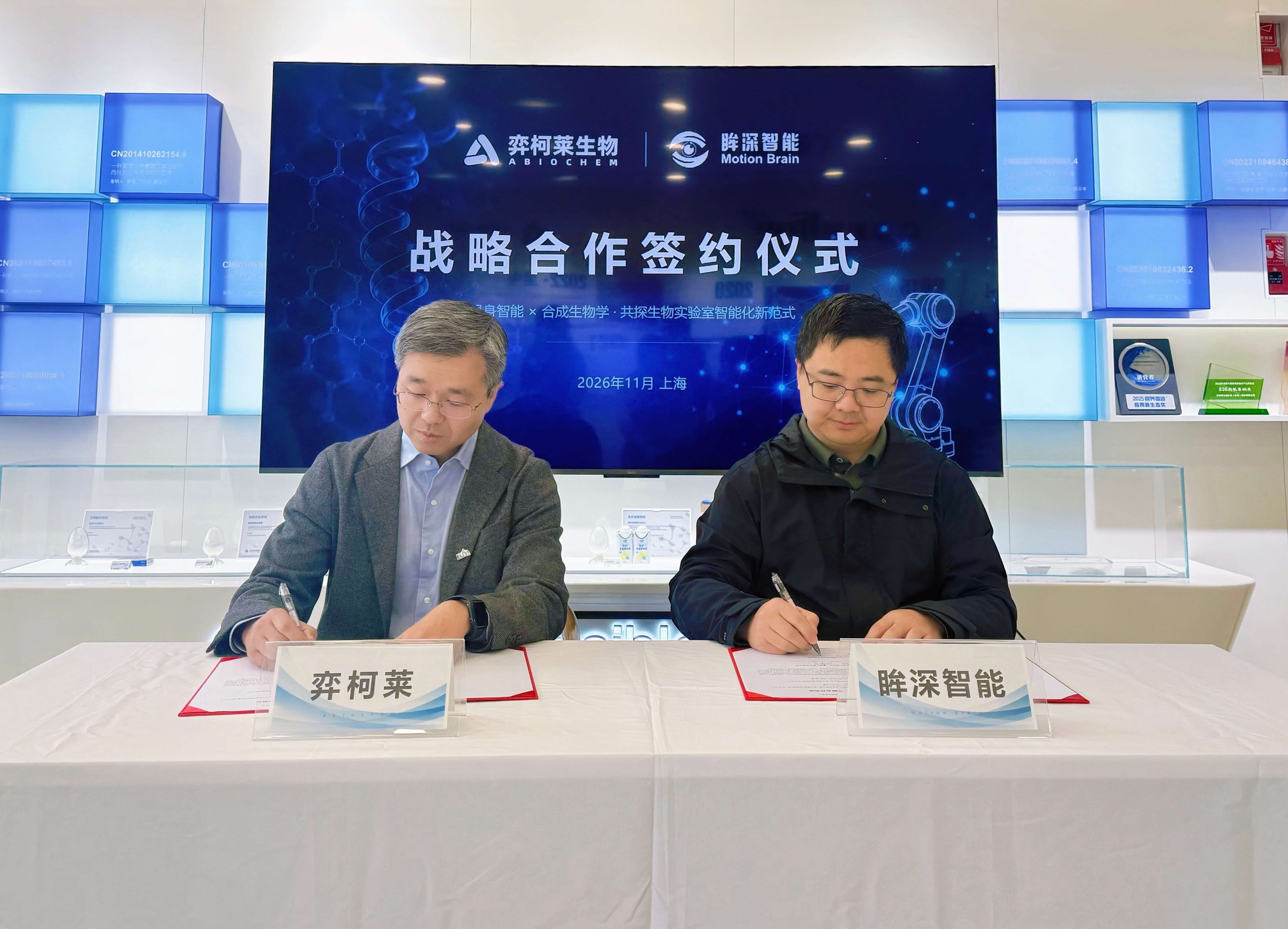
A Deep Complementarity Between a "Scenario Owner" and a "Technology Provider"
Synthetic biology is regarded as the foundational technology of the new bioeconomy, and its R&D efficiency is highly dependent on experimental throughput and operational consistency. As a globally leading synthetic biology and intelligent biomanufacturing enterprise, Abiochem's product pipeline spans biomedicine, green agriculture, and life sciences. The company is a national-level Specialized, Refined, Distinctive and Innovative "Little Giant" enterprise and a Shanghai Manufacturing Single-Product Champion. Around the synthetic biology "Design–Build–Test–Learn" (DBTL) R&D cycle, Abiochem has built three core technology platforms: whole-cell biosynthesis, enzyme-catalyzed biosynthesis, and large-scale green manufacturing. It has also self-developed multiple laboratory automation and data management systems, with rich high-throughput experimental scenario resources and system integration capabilities.
MOTION is an embodied AI enterprise focused on a general-purpose embodied brain that is "edge-based, generative, and cross-embodiment." It has achieved full-stack integration of motion control, 3D perception and planning, model compression and lightweighting, and software-hardware co-deployment. Its autonomous robot bodies integrate vision, navigation, grasping, and decision-making capabilities, enabling autonomous material handling and precise operations in unstructured environments. One party possesses real-world experimental scenarios, process know-how, and automation platforms; the other masters an embodied brain capable of precise execution in the physical world. The two parties' cooperation is highly complementary and strategically aligned.
Four Directions to Truly Integrate Robots into the Laboratory
The cooperation goes beyond hardware introduction; it aims to connect the entire chain — from algorithms and robot bodies to platform interfaces and data loops — focusing on four core directions:
1. Joint R&D of scenario-adaptive technology.
Focusing on the handling, transfer, loading/unloading, and recycling of materials — such as experimental raw materials, samples, reagents, and consumables — within laboratories and production workshops, as well as operational assistance needs in high-throughput experiments, strain construction and screening, fermentation processes, and purification and quality control, MOTION will, drawing on its embodied brain technology, custom-develop adapted models and robotic application solutions covering core modules of perception, decision-making, and motion control, and provide lightweight model deployment solutions to ensure compatibility and stability in real-world deployment.
2. System integration and collaborative interfacing.
Abiochem will lead the definition of control logic, data interfaces, and integration protocols for its automation platforms and data management systems, providing interface documentation, test environments, and safety interlock conditions required for joint commissioning; MOTION will support interface adaptation between robot bodies and platform systems. The two parties will jointly formulate technical and safety specifications for connecting robots to laboratory automation platforms, forming a standardized integration solution that is replicable and scalable to similar biomanufacturing scenarios.
3. Collaborative scenario data collection and model optimization.
Abiochem will leverage its own scenario resources to build a multi-scenario data collection system and establish standardized data storage and transmission mechanisms; MOTION will provide data processing and annotation support, using real-world scenario data to train and optimize embodied brain models, forming a closed-loop iteration of "data–model–scenario" that aligns with the digitalization needs of the synthetic biology DBTL R&D cycle.
4. Scenario deployment and collaborative business advancement.
The two parties will jointly identify intelligent upgrading needs in areas such as material flow and operational assistance, conduct joint market promotion, build benchmark human-robot collaboration cases for biological laboratories and biomanufacturing scenarios, and explore diverse cooperation models to jointly expand market share.
Why Now: Automation Stalled at the "Last Mile"
Over the past decade, automation in biological laboratories has largely followed the path of "fixed assembly lines + dedicated robotic arms." Individual equipment has grown increasingly capable, yet the physical flow between equipment — transporting samples and containers between stations, sterile docking from shake flasks to fermenters, sample loading and unloading, and recovering waste liquids and bottles — remains highly dependent on manual labor.
This "last mile" is precisely the hardest part to standardize: once a layout is fixed, it struggles to scale with evolving experimental protocols, and manual intervention introduces contamination risks and operational inconsistency. Embodied AI offers an entirely new approach: rather than pursuing equipment "rigidity," it endows robots with "generality." An autonomous mobile robot equipped with 3D environmental perception, autonomous navigation, flexible grasping, and adaptive task decision-making can dynamically connect various pieces of equipment just like a human, serving as the flexible logistics and loading/unloading link of the entire production line, thereby breaking the bottleneck of full-process automation.
About Abiochem
Founded in 2015, Abiochem Biotechnology (Group) Co., Ltd. is an intelligent biomanufacturing enterprise centered on advanced synthetic biology technology, dedicated to applying synthetic biology methods to large-scale production. Headquartered with its R&D center in the Zizhu National High-Tech Zone, Minhang District, Shanghai, the company operates two major production bases in Taizhou, Zhejiang, and Chongqing. It has built a large-scale biological resource engineering library platform and accumulated deep experience in biosynthesis, the design and creation of high-performance cell factories, and large-scale product manufacturing.
The company has long focused on the deep integration of artificial intelligence and synthetic biology. Through self-developed laboratory automation platforms and partnerships with leading external AI enterprises, AI technology has been progressively applied to experimental R&D and industrialization scenarios.
To date, the company has undertaken multiple national-level major scientific research projects, with over 260 patent applications cumulatively and 86 authorized core patents. Its product pipeline covers more than 20 varieties across three major sectors — biomedicine, green agriculture, and life sciences — with multiple products pioneering domestic first-to-file and first-to-approval precedents.
About MOTION
MOTION was co-founded by Professor Chen Tao, Director of the Deep Learning Laboratory at Fudan University; Dr. Zhang Yimin, former Chief Scientist of Intel China; and Mr. Mu Zelin, a serial entrepreneur with a leading investment banking background. It is the world's first company focused on a general-purpose embodied brain with edge-side generative capabilities. Leveraging core technologies including the world's pioneering MotionGPT and the HL3DWM world model, MOTION was the first to propose the global concept of a "World Motion Model" and a "human-centric" embodied brain paradigm. The company has won multiple accolades, including the global championship in HumanML3D human motion generation, the IJCAI 2025 Best Paper Award (the only recipient in six years), the CVPR 2024 championship in 3D dense semantic reasoning, and the ICCV 2023 global championship in 3D object recognition.
MOTION possesses globally leading and extremely scarce full-stack embodied large-model capabilities, and is currently the only team in the industry to achieve full-chain embodied integration of motion generation, world models, and edge-side software-hardware co-operation. It has established business cooperation with multiple leading industry clients, including Unitree, the National-Local Joint Humanoid Robot Innovation Center, Hechuan Technology, and China Telecom. Going forward, MOTION will continue to deepen cooperation with leading industrial partners, accelerate the application of robots in households, commerce, manufacturing, and other sectors, and build a general-purpose embodied brain platform with a market value exceeding RMB 100 billion.